

What if the West’s fixation with Eastern beauty isn’t about the search for better skin or what the next product can be added onto an already lengthened routine, but rather about a dissatisfaction with its own? Somewhere between the focus on procuring a “glass skin” complexion and a multi-step skincare ritual, Western consumers have decided that Eastern beauty philosophies–longevity, balance, and simplicity–are a universal answer.
Science doesn’t belong to any specific culture, so why do certain beauty routines insist otherwise?
Breaking it Down
It’s helpful to break down this framework by examining what it means when skincare is labeled as “Western” or “Eastern.” Partly created for marketing tactics and consumer categorization, the reality behind this classification is far less binary. While these terms tend to flatten diverse regions into antithetical ideals, they are often used to represent the postulated dichotomy that Western beauty practices are active and corrective — shorter routines that fulfill faster results — while Eastern practices are preventative and preservative, with a focus on extensively holistic methods that evolve into long-term skin protection.
This commercialized distinction between these two approaches can be simplified when understood through a physiological lens. Composed of multiple cell types, structural proteins, lipids, and water, the human skin is a complex organ composed of three primary layers — all universally functioning through processes that work to defend and protect the skin barrier. The line between Western and Eastern skincare is conceptual rather than biological, as these processes remain constant regardless of geographical or cultural customs.
While skin physiology is fundamentally universal, certain biophysical characteristics (barrier response, pigmentation, and sebum production) can vary across individuals. A review published in the IFSCC Magazine examined differences in skin structure andfunction across individual populations, noting variations in pigmentation and melanin production, as well as barrier behavior. However, these differences often overlap, and are influenced by genetics and environment rather than traditional or cultural skincare practices.
When biology fails to justify the divide, psychology intervenes. The West’s increasing fixation on Eastern health and beauty norms is rooted in perception and dissatisfaction, with overconsumption and immediacy fading as the desire for restraint and long-term maintenance takes the helm.
Tools and their Efficacy
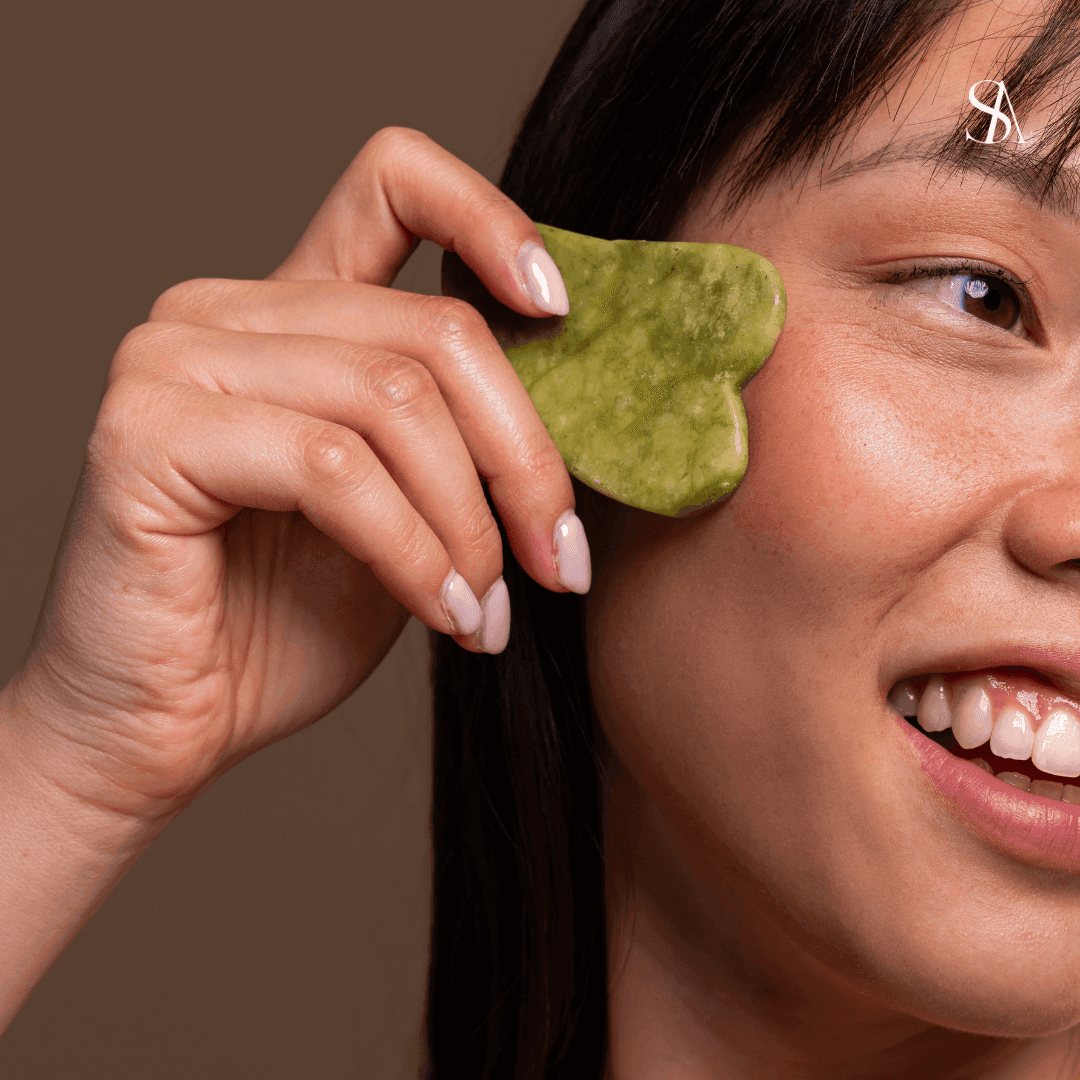
The gua sha and jade roller are two Traditional Chinese Medicine (TCM) tools that experienced a surge in popularity within Western beauty markets, driven primarily by K-beauty retailers and social media visibility. Often marketed as modern innovations, these traditional facial sculpting tools have existed for centuries–their purpose of wellness and circulation remaining consistent throughout the years.
From a dermatological standpoint, both tools function through physical and mechanical stimulation of the skin. A dermatological study examining facial sculpting tools and techniques describe their intended method of use:
“Gua sha treatment uses a polished jade stone to scrape skin gently. Jade rollers resemble a small paint roller made of jade stone used to massage skin. Both methods require an upward and outward motion to reduce inflammation, improve skin complexion, and decrease wrinkles.”
When used with gentle pressure, gua sha and jade rollers can increase superficial blood flow and encourage short-term lymphatic drainage, which may temporarily reduce facial puffiness and contribute to a more refreshed appearance. Additional research following gua sha treatment has shown a significant increase in surface microcirculation, meaning improved blood flow and oxygen delivery to the skin, further suggesting enhanced nutrient delivery and a boost in skin vitality.
According to an article medically reviewed by dermatologist Dr. Jabeen Begum, similar techniques are often used by licensed acupuncturists, physical therapists, and chiropractors:“Instead of gua sha, you might hear it called instrument-assisted soft tissue mobilization (IASTM). A small tool is used to help loosen up tight muscles or areas of scar tissue.”.
Frequently praised for their results of lifted features and permanent contouring, dermatological research suggests that these facial sculpting effects are not 100% permanent. The visible benefits, such as reduced puffiness and redness, mostly develop due to increased blood circulation and lymphatic movements rather than true structural changes to the face.
Touch-based practices — such as the gua sha and jade roller — have exhibited their activation of the parasympathetic nervous system, further contributing to stress reduction and an overall improved perception of well-being. When adopted into a Western consumer lens, these sculpting tools seem to shift in meaning. Removed from their traditional medical and cultural context, they become rebranded as beauty accessories rather than wellness practices. Still, their popularity in Western markets reflects the broader desire for simpler and gentler approaches to skincare.
Getting Ready: The Layered Ritual of the Multi-Step Routine
Multi-step skincare regimens are another notable aspect that have been popularized by Western consumers looking to Korea for their K-beauty tips and tricks. Often referred to as the “10-step routine,” this approach to skincare originated in South Korea as a flexible framework rather than a rigid prescription. Despite its specific name and portrayal as the direction to achieving “glass skin,” the routine does not require ten steps to be incorporated into a daily schedule. By layering product categories based on skin type and individual need, the skin receives treatment and protection in a controlled manner.
At its core, the routine prioritizes maintaining barriers and promoting long-term skin health over aggressive correction. For many, a regimen consisting of a gentle cleanser, hydrating moisturizer, and a clean sunscreen with SPF might be more than enough. The “10 steps” function less as a mandate and more as an option rather than an expectation. A typical “glass skin” routine begins with the lightest products first (cleansing, exfoliating, and using toners), then layering on the typically thicker products (serums, masks, eye creams, moisturizers, and sunscreens), but the placement and inclusion of these steps tend to vary based on individual needs. Similar to facial tools and ritualized application, layering skincare turns reactive maintenance into an intentional, patient practice that is customized for each skin type.
Analyzing the Psychology
It’s no surprise that the Western world’s healthy fixation on Eastern beauty culture is a response to something lacking within its own wellness and skincare industry. Kaley Roshitsh writes about this awareness shift in Women’s Wear Daily:
“The U.S., be it as a consumer or corporation, has a growing obsession with Eastern culture right now.”
The dramatic before-and-after transformation, rapid and visible results, and targeted treatment are attitudes that dominate Western skincare, demonstrating a psychological methodology toward efficiency and productivity. Conversely, many Eastern beauty philosophies frame the relationship with skin as a practice of maintenance and patience, rather than treating the skin as an obstacle to solve. Psychologically, this habitude changes a reactive mindset to one of prevention and diligence. Instead of a technical routine, the mindful and structural mindset turn skincare into a holistic experience.
Western consumers are tired of the outcome-driven skincare standards and are searching for the calmness and care that ties into well-being.
So… Is the Obsession Sensible, Scientifically?
When examined objectively, the East–West divergence in beauty and skincare becomes more of a matter of perception. Skin functions the same physiologically, while blood circulation, lymphatic drainage, and barrier repair remain constant — it’s not a difference in science, but rather a difference in framing. Facial sculpting tools like gua sha and jade rollers are effective not because they are inherently “Eastern” or “Western,” but because their mechanical stimulation produces consistent, physical responses in human tissue.
Instead of replacing one system with another, modern skincare culture is unifying and moving towards integration. The growing interest of Eastern wellness philosophies and skincare culture highlights a breakaway from established priorities and into a transformation of how people care and understand for themselves — both internally and externally.
The fascination with Eastern beauty norms reflects a difference in cultural storytelling rather than a scientific necessity — at the end of the day, this fixation highlights a gradualshift away from immediacy and correction toward mindfulness and intention in skincare rituals.