

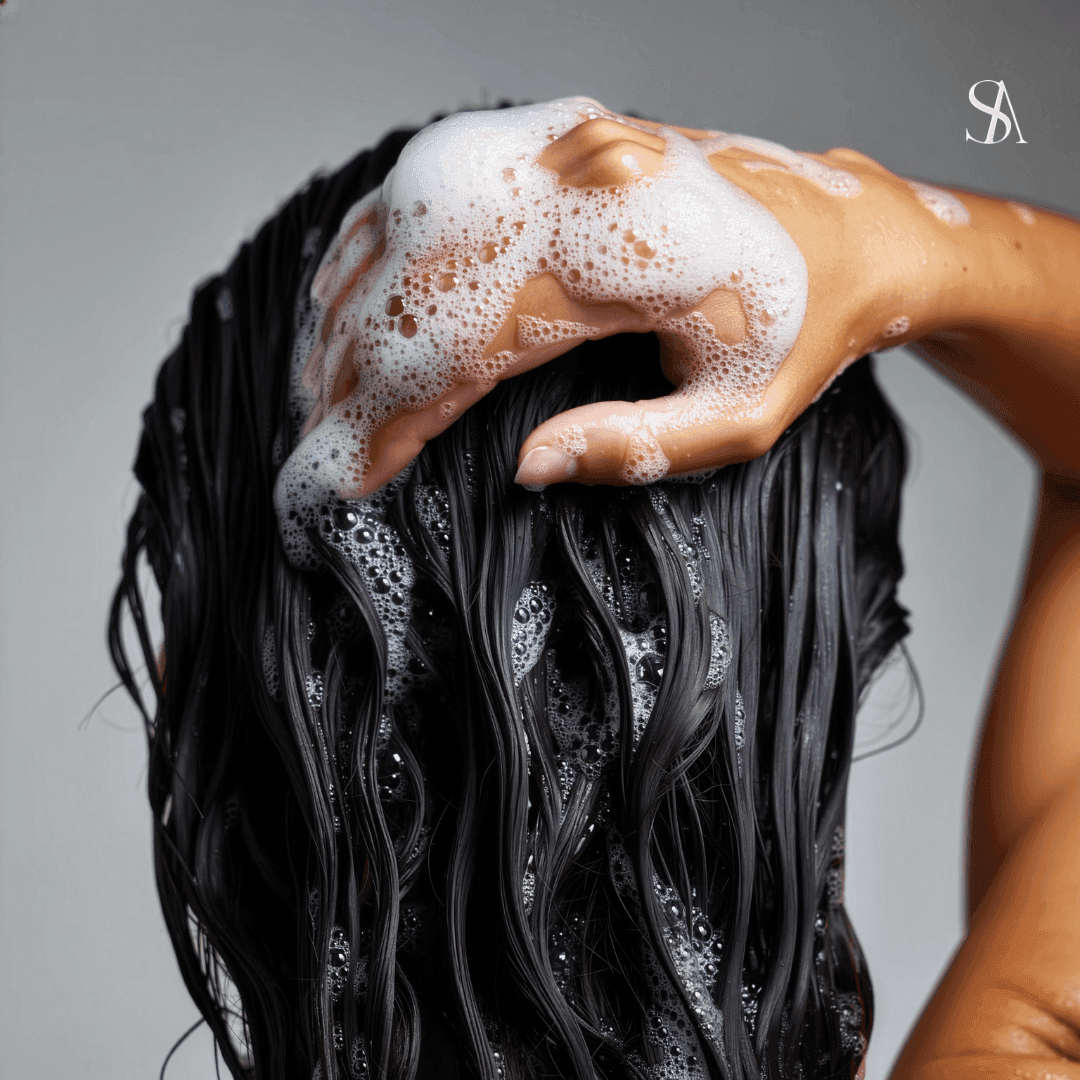
Breaking down the differences in single-purpose and multifunctional hair care from formula to label. What products are actually your money’s worth?
There’s nothing quite like the choice paralysis in the hair aisle. There are rows and rows of fully-stocked, multicolored shelves; some are hydrating shampoos, others are pre-rinse detangling products. As a consumer, it seems impossible to find the exact right combination of products to maintain silky smooth, healthy hair. Ostensibly, the fact that everyone has differences in hair type and specific concerns would result in a variety of specialized products, all varying in price. What’s tempting is to just pick up a cheap 3-in-1 shampoo/conditioner/body wash and call it a day.
The question is, are multifunctional products the better option? The cultural idea of an all-in-one buyer is someone who either doesn’t know about good hair maintenance or doesn’t care. It certainly appears more cost-effective to buy a basic brand of combined shampoo and conditioner. So, are the fancy, specialized products simply a result of marketing and equally as effective as your standard 2-in-1? Well, it depends on what “effective” means.
Understanding Shampoo: Formulation and Function
Like other products intended for cleansing, shampoo is primarily used to remove grime from hair, whether it be pollutants, styling products, dirt, or more. The way that hair gets dirty is quite interesting on a molecular level: sebaceous glands in the scalp secrete an oil, sebum, that ends up on our hair strands. Sebum is what adds shine to hair, but it is also the perfect sticky trap for buildup that needs to be removed.
The Cleaning Factor of Shampoo
In order to do this, we need a compound for the grime to stick to and wash away with water. Surfactants are our solution– they function in both of these ways. Surfactants for cleansing connect with fats and water, which helps clear away unwanted substances. This seems straightforward enough: the best shampoo is just whatever has the most and best surfactants to entirely clean each hair strand. However, hair that is sufficiently clean isn’t generally what consumers are looking for.
The Five General Surfactant Types, as explained in Clinics in Dermatology:
Anionic The part of the surfactant that is hydrophilic (has an affinity for water) has a negative charge.
Pros: Lathers well, easy to dissolve in water and therefore rinse out
Cons: Complications with hard water, may not meet a user’s expectations of clean hair
Cationic The part of the surfactant that is hydrophilic has a positive charge.
Pros: Can link well with hair strands, results that users generally expect (smoothness, softness)
Cons: Doesn’t lather well, might not rinse grime out effectively
Amphoteric Can change to be anionic or cationic based on pH, or the acidity.
Pros: Lathers moderately, can be used in combination with other surfactants for gentle(mild) shampoo
Cons: Can diminish effectiveness of anionic detergents
Nonionic These surfactants are not positive or negatively charged. They are often mixed in with other surfactants to increase the properties of a shampoo.
Pros: gentle on skin, can disperse well among hair strands
Cons: Doesn’t lather well, ineffective at cleansing alone
Natural Surfactants of the previous four types can be obtained via natural ingredients, often plants. The links to water, hydrophilic components, are similar to nonionic surfactants.
Pros: Can lather well, depending on the specific ingredient
Cons: effective cleaning needs high concentrations, which may amplify stripping effects
It’s important to note that formulas often contain multiple surfactants of different types, which can amplify or hinder how well sebum and debris is removed from hair.
Removing grime by trapping and then rinsing dirt, product, and sebum means that the benefits of oil in hair are also removed. Hair that is technically clean could result in a lack of shine, detangling woes, and missing hair smoothness, all of which are amplified by individual hair type. The cleanliness that most users are looking for is hair that feels light, smooth, and appears shiny. Because of this dissonance between “technical-clean” and “user-clean,” most shampoos are formulated either to be less stripping or with some aspect of conditioning mixed in.
The Overlap Between Specialized Hair Care and Single-Step Cleansers
Shampoo that’s effective, as a result, needs sulphates to stick to oils and wash out as well as compounds to deposit or retain useful material. In this way, shampoos that aren’t also advertised as conditioners do still accomplish multiple goals by either cleansing more mildly to keep natural oils, or having additional conditioners in its formula.
Does this mean that all clarifying shampoos are actually just mild cleansers without additives to condition hair? Not necessarily. Rather, there are a variety of factors including the ingredient list, concentrations of surfactants, the label on the bottle, and even what someone means when they say “clean” that blurs the distinction between a product being one step in your wash day or the entire routine.
Should I Choose a 2-in-1 for My Next Hair Wash Day?
Overall, the amount of products in your rotation is entirely dependent on what you want from your hair cleansers. There might also be different options to choose from depending on what you mean by “clean.” In addition to factors like individual hair type and goals, how much you buy should also allow space for the amount of thought and energy you choose to put into this aspect of self care.
For the cost-cutter
While the social image we have of 2-in-1 shampoo is its humble status as the cheapest option, new ingredients and formulations have also made cleaning-focused and conditioning-focused products relatively accessible. If the perception of a cheap, jack of all trades, master of none product is all that’s keeping you from going for an all-in-one, rest assured that this concept is likely a result of marketing rather than formulation.
For the time-saver
For those who prioritize a quick shopping trip and even faster shower routine, 2-in-1 shampoo and conditioners are a single step that can make your hair feel clean. According to a study on water consumption in hair cleansing, the formula of your product can affect how much time (and water) you spend rinsing things out.
Conditioning ingredients in multifunctional shampoos could counteract how easily cleansers can be rinsed out, because they are natural or synthetic lipids that are what surfactants cling to. In the article, researchers suggest that shampoos with surfactants that lather and combine with water well might save rinse time when shampooing, but may require a separate, specialized conditioner to reach our consumer idea of clean hair.
If a single scrub and rinse is your idea of a time-saver, 2-in-1 shampoo (also sometimes called daily shampoo) works well and likely won’t be too “technically clean” or not “clean feeling”.
For the routine-strategizer
If you are open to changing up what products you use on a given wash day, a 2-in-1 can easily take the role of your daily driver. That is, the effectiveness of multifunctional shampoo and conditioners can be enough for your hair to feel clean on wash days where you don’t have too much buildup of dirt and oil.
At the same time, the contrasting effects of cleansing and conditioning ingredients might limit the ability of your all-in-one to get a full “technical clean.” Changing things up on occasion when you feel more buildup than usual or have an extra amount of product might be the move for you. Having specialized surfactant-centered shampoos to really get in there and conditioners to give you sleekness and shine when needed are nice to have in your toolkit.
For the hair-health interpreter
Some consumers might have a specific issue they want to address– excess sebum production, wrangling dandruff, managing chemically treated hair, etc. 2-in-1s might not be the best path forward here, as the use of compounds with different goals in one formula might inhibit the effectiveness in addressing your concerns.
For the fine-print reader
Consumers that prioritize ingredient lists may also not be as enthusiastic about a single product that accomplishes multiple goals. If you are more discerning about what exactly you’d like in your cleanser, and conditioner, you’ll probably have more satisfaction in finding individual products that include what you want. It is important to keep in mind, though, that shampoos that aren’t marketed as multipurpose may still have conditioning additives to help achieve that user-focused clean and shiny look.
If you enjoy digging into what makes up your hair care routine, there’s an entire world of formulation to explore. Factors like surfactant type and natural versus synthetic ingredients can also be impacted by your hair type, thickness, and even length. Understanding the effects of these variables can help you determine exactly what you’re looking for.
As is often the case, understanding what makes a good hair product is a lot more complex and nuanced than it seems. Equipped with the fundamentals of surfactants, lipids, and how cleansing physically works, you may find picking from a wall of products a little less intimidating.